
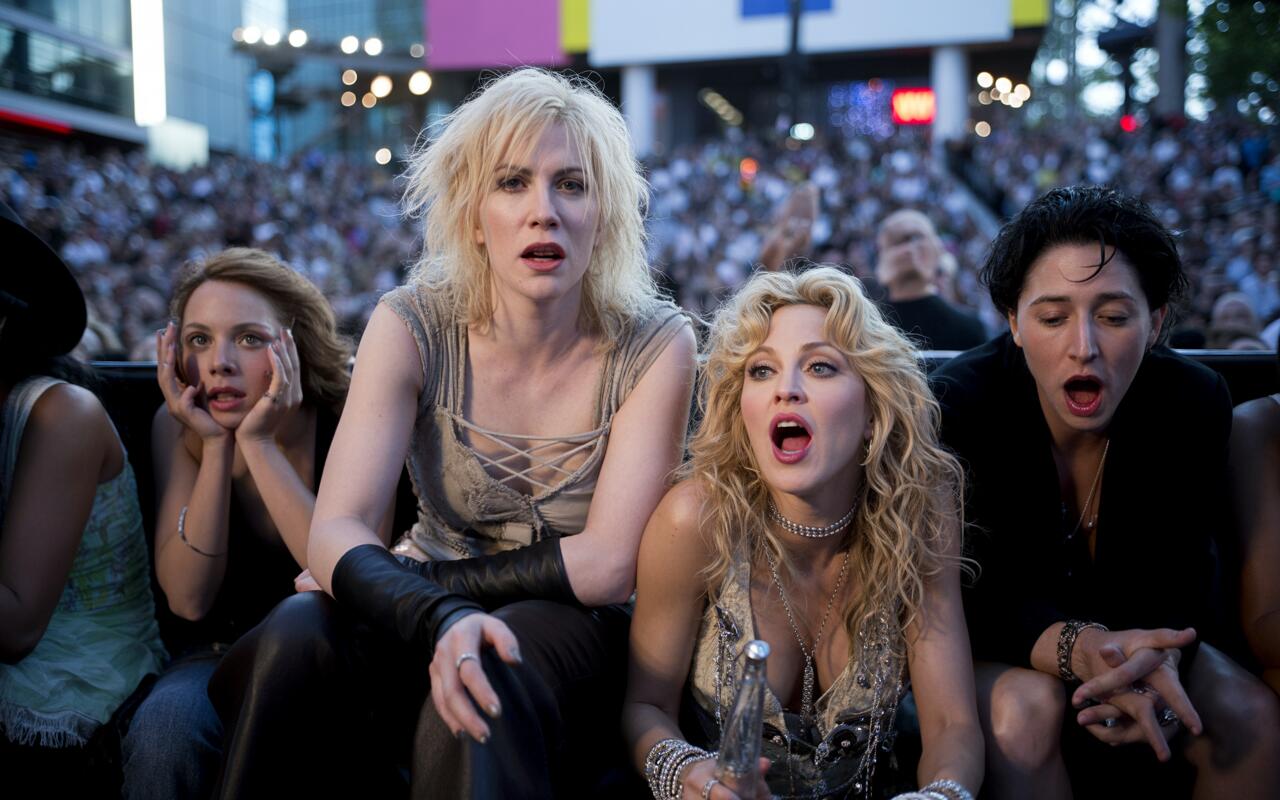

A key witness reveals what really went down during one of the most talked-about moments in 90s pop culture
September 7, 1995: Radio City Music Hall Sets the Stage
The 11th annual MTV Video Music Awards unfolded at New York’s legendary Radio City Music Hall on what would become a night etched in entertainment history. Among the evening’s standout moments was an unexpected confrontation between Courtney Love and Madonna that captured the raw, unfiltered energy of 90s celebrity culture—long before social media turned every interaction into instant content.
Eduardo Braniff, an MTV executive who found himself assigned to wrangle Love and her band Hole throughout the event, witnessed the chaos firsthand. What started as routine artist management quickly evolved into something far more unpredictable. Braniff had dealt with demanding performers before, but Love’s spontaneous antics that night would cement her reputation as one of rock’s most volatile personalities.
The Moment That Stopped Television
As the ceremony wound down and guests filtered out, Love made her move. She spotted Madonna mid-interview with MTV’s Kurt Loder on a platform just outside the venue and decided to crash the party. Armed with makeup compacts from her purse, Love literally threw herself into the live broadcast, creating television gold in real time.
Madonna’s response was swift and cutting: she told Loder not to let Love join them, adding with trademark precision that \”Courtney Love is in dire need of attention right now.\” The exchange crackled with tension, serving up the kind of unscripted drama that would later inspire countless viral moments—think Kanye and Taylor Swift, but with more eyeliner and attitude.
This wasn’t just celebrity beef; it was a collision between two very different worlds happening at the exact moment MTV ruled the cultural conversation.
Two Stars, Two Very Different Trajectories
Madonna arrived that night riding high on her artistic renaissance. Her \”Bedtime Stories\” album had marked a successful pivot from controversy to credibility, and she was already deep in preparation for her starring role in Evita. By 1995, she was a VMAs institution—her performances had become appointment television, from that unforgettable \”Like a Virgin\” debut in 1984 to the voguing masterpiece of 1990.
Courtney Love occupied a much more complicated space. Just eighteen months removed from Kurt Cobain’s devastating suicide, she remained the reluctant face of grunge’s aftermath. Her VMAs performance of \”Violet\” that night carried emotional weight—a dedication to Cobain, River Phoenix, and other friends lost too soon. Braniff remembers Love’s frustration with MTV’s lukewarm promotion of Hole’s latest work, a grievance that may have fueled her impromptu television takeover.
Chaos Management: A Night to Remember
Managing Love’s entourage felt like \”herding cats,\” Braniff recalls with a mix of exhaustion and admiration. The group included Hole bandmates Eric Erlandson, Patty Schemel, and Melissa Auf der Maur, plus actress Drew Barrymore, Love’s toddler Frances Bean Cobain, and a nanny trying to maintain some semblance of normalcy amid the rock star madness.
When Love suddenly veered toward Madonna’s interview, the production team didn’t panic—they recognized ratings gold. The resulting four-minute segment delivered peak 90s absurdity: Love rambled about fame being like hospital work while Madonna fired back about \”a lot of available drugs.\” The exchange ended with awkward air kisses and Love eventually gravitating toward MTV News’ Tabitha Soren for a friendlier chat.
A Study in Contrasts
The visual alone told the story. Madonna, immaculate in Tom Ford couture, represented polish and calculated glamour. Love, disheveled in her signature \”baby doll\” aesthetic, embodied grunge’s deliberate rejection of traditional pop star presentation. Two women, two generations, two completely different approaches to fame and femininity colliding under the bright lights of Manhattan.
Their relationship never warmed up. Both appeared on Rolling Stone’s 1997 Women of Rock cover alongside Tina Turner, but it was professional obligation rather than genuine camaraderie. Love later admitted their mutual dislike, though she maintained respect for Madonna’s early film work—perhaps the closest thing to a compliment either would offer publicly.
When Television Mattered Most
MTV’s Kurt Loder captured the significance immediately, calling it \”wonderful television\” and recognizing the rarity of such unguarded celebrity interaction. Neither Madonna nor Love has revisited the moment publicly since, and both declined comment requests for recent retrospectives. But Braniff’s perspective offers insight into why this particular clash resonated so deeply.
\”Back then, the media landscape was completely different,\” he reflects. \”You didn’t get multiple rounds in celebrity feuds like you do now. This was a perfect capstone to that night and that entire era.\”
The 1995 VMAs confrontation remains a time capsule from when television still had the power to create shared cultural moments—before Twitter storms and Instagram subtweeting diluted the impact of celebrity drama. Two icons, one microphone, and four minutes of pure, unfiltered 90s energy.
Keywords: Courtney Love, Madonna, 1995 MTV VMAs, MTV, Kurt Loder, Hole, 90s pop culture, celebrity rivalry
